
Restaurant labour cost percentage: how to work it out and what moves it
- Published
- Updated
Yes Chef makes restaurant management software. This page is written by us. The worked figures are made-up examples, not benchmarks, and this is not financial advice.
In short
- Labour % is wages divided by sales, times 100. Use sales net of VAT, without tips.
- Work it out every week, then by day and by service. A week that looks fine can hide a day that does not.
- Track sales per labour hour beside it. It tells you whether a change came from rates or from hours.
- There is no right number to copy. The target comes from your own budget.
The sum
Labour cost percentage is what you paid your team, divided by what you took, times 100.
An example with made-up numbers: a week with £4,800 of wages and £20,000 of sales is 4,800 ÷ 20,000 × 100 = 24%.
The sum is simple. The arguments are about what goes into each side of it, so settle that first and keep it the same every week.
What to count as wages
- Hours actually worked, at each person’s rate. The rota is the plan; the timesheets are what happened.
- Salaried staff. A salaried head chef or manager still costs money in a quiet week. Spread the salary across the weeks and include it, or you are measuring only part of the team.
- Overtime and paid breaks, if you pay them.
The simple figure leaves out the costs that sit on top of wages: employer’s National Insurance, pension contributions and holiday pay. They are real and they rise with the wage bill. The wages-only figure is quick to track week to week; add the rest when you budget. Either is fine. Say which one you mean.
What to count as sales
- Net of VAT. VAT is not yours. A percentage worked out on gross sales looks better than it is.
- Without tips and service charge. They belong to the staff, not to the sales line.
- After discounts, so the figure is what guests paid.
Weekly, then daily, then by service
A monthly figure tells you what happened after it is too late to change it. A weekly one can be acted on, because next week’s rota is not written yet.
Then break the week up. The same made-up week, by day:
| Day | Wages | Sales | Labour % |
|---|---|---|---|
| Tuesday | £520 | £1,300 | 40% |
| Friday | £840 | £4,200 | 20% |
| Saturday | £900 | £5,000 | 18% |
| Whole week | £4,800 | £20,000 | 24% |
The week reads 24%. Tuesday reads 40%. A weekly figure that looks fine can hide a day that loses money, and the same is true inside a day: a lunch service and a dinner service rarely cost the same share.
The second figure: sales per labour hour
Divide sales by the hours worked. In the example, £20,000 of sales over 400 hours is £50 of sales for every hour someone was on the clock.
It is useful because pay rises do not move it. If labour % goes up and sales per hour is flat, your rates rose. If sales per hour fell, you had too many hours on for the trade.
What should the number be?
We are not going to give you one. Any figure quoted as “typical” ignores your rent, your menu, your prices and how much is made in house. A kitchen that butchers and bakes carries more labour and buys cheaper food than one that buys both in.
The target is your own. Work it from your budget: what the business must keep after food, rent and the rest tells you what share of sales the team can cost. Then write it down as a range, and judge each week against it.
What moves it
- The sales forecast. The rota is written against a guess at trade. A better guess is the cheapest saving there is. Start from the same weekday in recent weeks.
- Start and finish times. Half an hour off the front of six shifts is three hours, every day.
- Breaks. Whether they are paid, and whether they are taken when it is quiet or when it is busy.
- Overtime. Hours over contract usually cost more than hours given to someone under theirs.
- Who is on at which rate. Two rotas with the same hours can cost different amounts. Rates also go by age at the bottom of the scale: from April 2026 the minimum is £12.71 an hour for those aged 21 and over, £10.85 for 18 to 20 and £8.00 for under 18s (GOV.UK, rates).
- Sales. The percentage has two sides. A quiet Tuesday can be fixed by cutting hours or by filling tables.
When the minimum rates rise each April, the percentage moves even if nothing else does. See minimum wage rates for restaurant staff for the rates and what a rise adds to the weekly bill.
Work yours out
Our labour cost calculator does the sum for your own figures.
Labour cost in Yes Chef
In Yes Chef every shift is costed at what its person is paid, so the rota shows what the week will cost while you are still building it. Type the sales you expect for a day and that day’s labour percentage appears beside it. A day without a target is planned on its forecast, which comes from the same weekday in recent weeks.
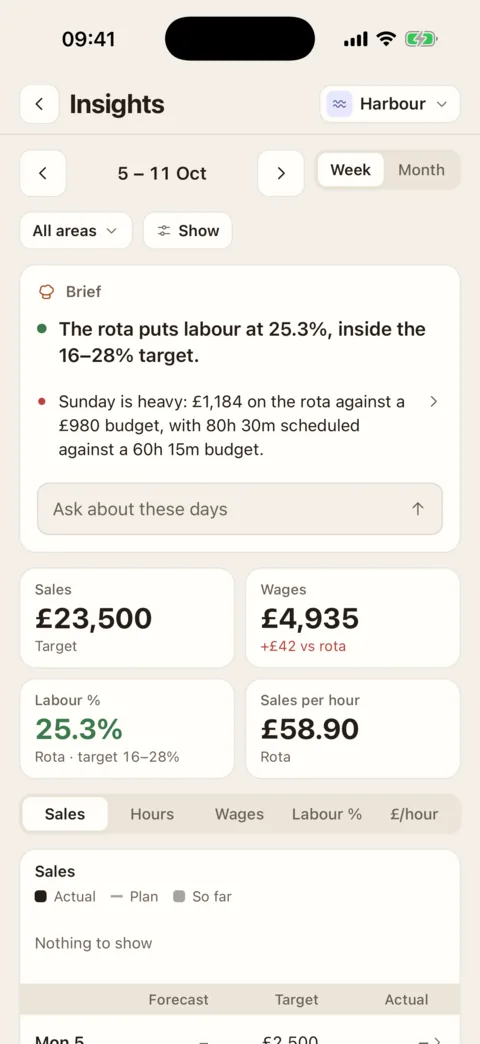
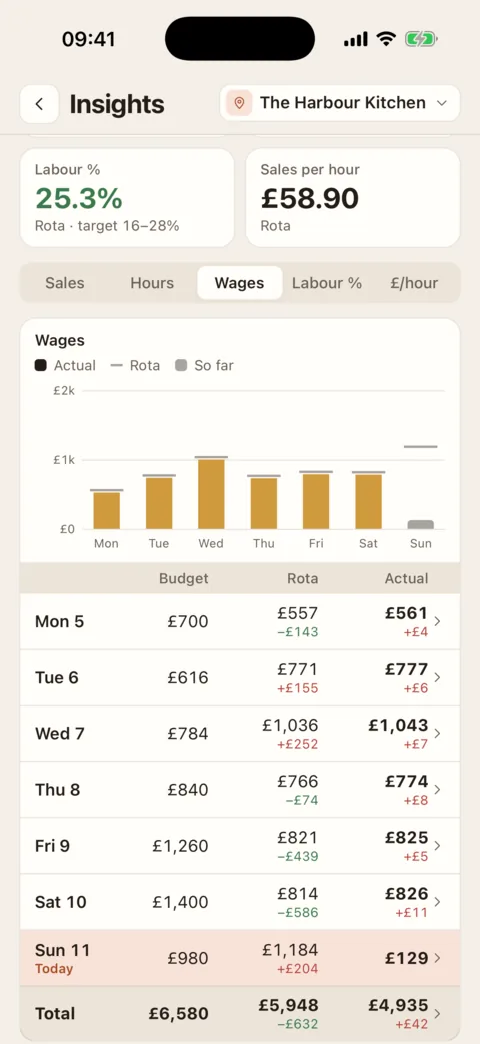
Insights sets three things side by side for each day: what you budgeted, what the rota schedules, and what happened. It shows sales, wages, labour % and sales per hour for a day, a week or a month, with the labour figure coloured against your location’s own labour target. Actual sales are net of VAT, and come from the till where one is connected.
The cost figures are wages at each person’s rate. They are shown to people who build the rota; employees never see cost. Yes Chef does not set your target for you, and it does not run payroll.
Questions people ask
How do you calculate labour cost percentage in a restaurant?
Divide wages by sales and multiply by 100. For example, £4,800 of wages against £20,000 of sales is 4,800 ÷ 20,000 × 100 = 24%. Use sales net of VAT, and use the same definition of wages every week.
Should labour cost be worked out on sales with or without VAT?
Without. VAT is collected for HMRC and is not the restaurant’s income, so a percentage worked out on gross sales looks lower than it really is.
What is sales per labour hour?
Sales divided by the hours worked. For example, £20,000 of sales over 400 hours is £50 per labour hour. Unlike labour %, it does not change when pay rates change.
Does labour cost percentage include employer’s National Insurance and pension?
It depends on the definition you choose. The simple figure counts wages only. Employer’s National Insurance, pension contributions and holiday pay sit on top of wages, so say which version you are using and keep it the same.
See how it works, step by step
Sources
The minimum wage rates quoted are as GOV.UK’s page stood on 17 November 2026. Everything else on this page is method and our own arithmetic, with made-up example figures. It is not financial or legal advice.
- GOV.UK, National Minimum Wage and National Living Wage rates: gov.uk/national-minimum-wage-rates (read 17 November 2026)
All product names are trade marks of their owners. Yes Chef is not affiliated with any of them. If something here is wrong or out of date, write to omar@1273.co.uk and we will correct it.
Want Yes Chef for your restaurant?
The first three months are free. It is offered to a limited number of restaurants, and we set each one up ourselves, so there is no sign-up form and no published price. Write and tell us about yours.
Get in touchNot your restaurant? Refer a restaurant. When it becomes a paying customer, we pay you £500. How referring works