
HACCP software for UK restaurants: what the rules ask for and what software can do
- Published
- Updated
Yes Chef makes restaurant management software. This page is written by us: a summary of official guidance as of the date shown, not food-safety or legal advice.
In short
- A food business must have food safety management procedures based on HACCP principles, and must be able to show its records.
- HACCP is two jobs: writing the plan, and running the daily checks and records. Software does one or the other.
- Small restaurants can use the Food Standards Agency’s Safer food, better business pack as the plan. Its diary can be kept electronically.
- Yes Chef runs the daily checks and keeps the record. It does not write the plan, and it has no sensors.
What the rules ask for
A food business must put in place food safety management procedures based on the principles of HACCP, which stands for Hazard Analysis and Critical Control Point (Managing food safety). The guidance describes HACCP as a system that helps you identify potential food hazards and introduce procedures to make sure they are removed or reduced to an acceptable level.
To meet the principles, the guidance on food safety management systems says you need to:
- identify any food hazards that need to be avoided, removed or reduced
- identify the critical control points (CCPs)
- set limits for those points
- monitor them
- put checks in place to make sure your system is working
- put things right if there is a problem
- keep records of your food safety systems, checks and how you’ve put things right
It names three types of hazard: microbiological, chemical and physical. And it says you will need to show your records as evidence of how you keep food safe.
Two jobs: the plan and the records
That list is two different jobs. Steps one to three are the plan: working out what could go wrong in your kitchen, where you control it, and what the limit is. Steps four to seven are the day-to-day: doing the checks, acting when one fails, and keeping the record.
Software sold as “HACCP software” does one job or the other, and sometimes both. A plan builder helps you write the plan. A checks app runs the day-to-day. Know which one you are short of before you look at products.
Most small restaurants already have a plan: the SFBB pack
The Food Standards Agency publishes Safer food, better business (SFBB), which sets out food safety management procedures for small businesses. The pack for caterers is described as being for restaurants, cafés, takeaways and other small catering businesses. Its sections cover cross-contamination, cleaning, chilling, cooking and management, and it comes with a diary. The management section includes opening and closing checks and a part called “Prove it”.
The guidance says the pack must be completed for all your food operations, with daily records kept in the diary. You should store completed diary pages safely until your next visit from a local authority food safety officer, who may want to look at them as well as the pack.
The pack applies to England and Wales. For Northern Ireland the same page points to the Safe Catering guidance instead.
Can the records be digital?
Yes. The SFBB guidance itself says you can keep an electronic diary or print the paper one. What matters, in the words of Managing food safety, is that all your records are kept up to date and are available for inspections at all times. The same page tells you to keep up-to-date documents and records relating to your procedures, and to review the procedures regularly.
What to look for in the software
Taking the last four HACCP steps in turn:
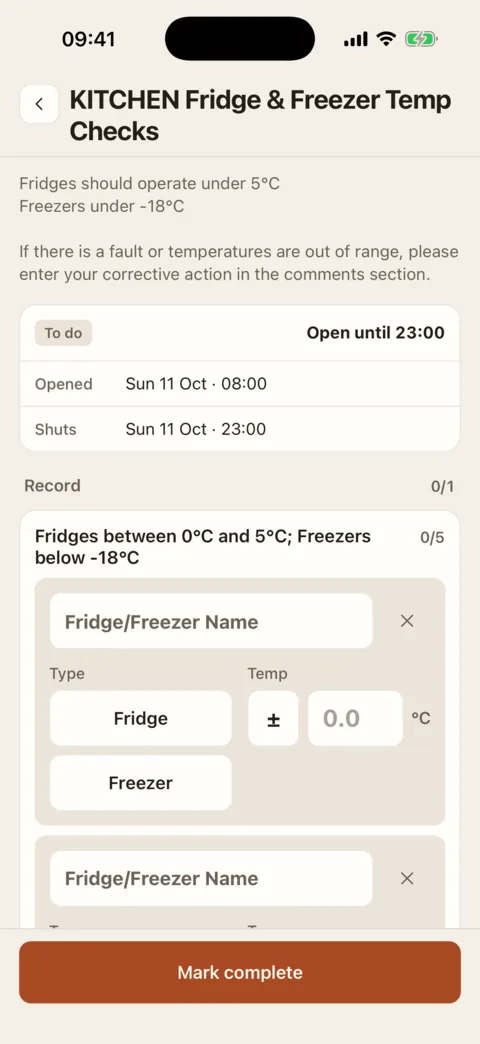
- Monitoring. Each check asked for at its time, with the limit written on it, so the person doing it does not have to remember that chilled food must be kept at 8°C or below.
- Checking the system works. A missed check has to show as missed. A list that only shows what was done cannot tell you what was not.
- Putting things right. A failed reading needs somewhere to go: an action with a name and a date on it, linked to the reading that caused it.
- Records. A time and a name on every entry, recorded when the check was done. And a way to get the whole record out, for an inspector on the day and for yourself if you change supplier.
Then the practical points: whether it works on a shared tablet as well as personal phones, and what it does when there is no signal in the walk-in.
What no software does
It does not decide your hazards or your limits, and it does not make a kitchen compliant. The duty is the business’s. An app that records a fridge at 11°C has done its job; what happens to the food is still up to the person holding the phone.
Where Yes Chef fits
Yes Chef does the day-to-day half. It does not write a HACCP plan. You bring your plan, whether that is your SFBB pack or one written for you, and set its checks up in the app.
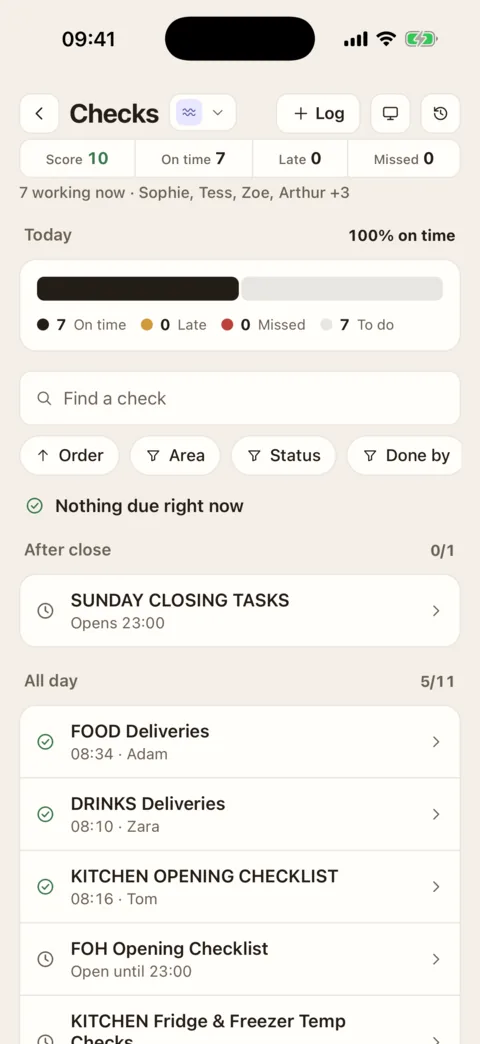
- Checks are asked for at their time, and each record carries the time and the name of the person who did it. The completion time comes from the system clock and cannot be typed.
- A check not done in time shows as late or missed, and missed checks stay in the record.
- A failed answer can raise an action: a task linked to the check, with who it is for and when it is due.
- There are ready-made checks to start from, such as opening and closing checklists and temperature logs. They are general: you edit them to match your own plan.
- Checks can be done on a phone, without a signal, or on a shared tablet with a PIN for each person.
- The inspector pack puts the records for a range of dates into one document to print or save as a PDF, missed checks and failed readings included.
Yes Chef has no temperature sensors or probes, no HACCP plan builder and no food-safety advice line. If you need one of those, read our comparison of food safety check apps, which covers the products that have them and what each publishes as a price.
Questions people ask
Is HACCP a legal requirement for restaurants in the UK?
Yes. The Food Standards Agency’s guidance says a food business must put in place food safety management procedures based on the principles of HACCP. It adds that where processes are very simple, following good hygiene practice can meet the requirement.
What are the HACCP steps?
In the Food Standards Agency’s words: identify any food hazards that need to be avoided, removed or reduced; identify the critical control points; set limits for them; monitor them; put checks in place to make sure your system is working; put things right if there is a problem; and keep records of your systems, checks and how you’ve put things right.
Can HACCP records be kept digitally?
Yes. The Safer food, better business guidance says you can keep an electronic diary. Records need to be up to date and available for inspections at all times.
Is Safer food, better business the same as HACCP?
Safer food, better business is a pack from the Food Standards Agency that sets out food safety management procedures for small businesses, including restaurants, cafés and takeaways. The packs are meant to help a business comply with food hygiene regulations and show how it makes and stores food safely. It applies in England and Wales; Northern Ireland uses the Safe Catering guidance.
Does HACCP software make a restaurant compliant?
No. Software can ask for checks, time them and keep the records. Deciding the hazards and limits, doing the checks and acting on a failure remain the food business’s responsibility.
See how it works, step by step
Sources
The Food Standards Agency’s guidance as these pages stood on 17 November 2026. They apply to England, Wales and Northern Ireland unless they say otherwise. This page is a summary, not food-safety or legal advice.
- GOV.UK (Food Standards Agency), Food safety management systems for businesses: gov.uk/food-safety-management-systems (read 17 November 2026)
- GOV.UK (Food Standards Agency), Managing food safety: gov.uk/government/publications/managing-food-safety/managing-food-safety (read 17 November 2026)
- GOV.UK (Food Standards Agency), Safer food, better business (SFBB): gov.uk/government/publications/safer-food-better-business-sfbb/safer-food-better-business-sfbb (read 17 November 2026)
- GOV.UK (Food Standards Agency), Safer food, better business for caterers: gov.uk/government/publications/safer-food-better-business-for-caterers (read 17 November 2026)
- GOV.UK (Food Standards Agency), Food hygiene for your business: chilling and freezing: gov.uk/food-hygiene-businesses/chilling-and-freezing (read 17 November 2026)
All product names are trade marks of their owners. Yes Chef is not affiliated with any of them. If something here is wrong or out of date, write to omar@1273.co.uk and we will correct it.
Want Yes Chef for your restaurant?
The first three months are free. It is offered to a limited number of restaurants, and we set each one up ourselves, so there is no sign-up form and no published price. Write and tell us about yours.
Get in touchNot your restaurant? Refer a restaurant. When it becomes a paying customer, we pay you £500. How referring works