
Restaurant opening and closing checks: what goes on the list, and how to keep the record
- Published
- Updated
Yes Chef makes restaurant management software. This page is written by us. The example checklists are ours, to adapt; they are not official lists and not food-safety advice.
In short
- Opening and closing checks are part of the Food Standards Agency’s Safer food, better business pack for caterers, with a daily record in its diary.
- They are there to catch the basics: cold fridges, a clean kitchen, allergen information that matches the menu.
- A good list is short, asks for readings and not ticks, has a time it is due by, and has a name on it.
Why kitchens have them
Opening and closing checks are part of the Food Standards Agency’s Safer food, better business pack for caterers: they sit in its management section, beside “Prove it”, training, suppliers and stock control. The pack’s guidance says daily records are kept in its diary (SFBB guidance).
They earn their place for a plain reason. A kitchen is handed over twice a day, usually between people who do not meet. The closing check is the note the night shift leaves; the opening check is the morning shift reading it and looking for themselves.
What the guidance says must be in order
These are the rules an opening or closing list is there to catch.
- Cold. Chilled food must be kept at 8°C or below, with the fridge set to 5°C or below (chilling guidance).
- Clean. You should set up a cleaning schedule and record. It must cover what needs to be cleaned or disinfected, how often, and which products to use. Disinfectants should carry BS EN 1276 or BS EN 13697 on the label, and cleaning products are stored away from food (cleaning guidance).
- Raw and ready-to-eat. Food areas and equipment are cleaned and disinfected after they have been in contact with raw food.
- Allergens. You must be able to give allergen information for every item that contains any of the 14 allergens, and the guidance says to keep that information up to date and consider the impact when recipes change (allergen guidance).
- Records. All your records need to be up to date and available for inspections at all times (Managing food safety).
An example opening check
Done before any food is prepared.
- Fridges and freezers are running, and each fridge’s reading is recorded.
- Last night’s closing check is done, and anything it raised has been read.
- Hand-wash basins have hot water, soap and paper towels.
- Surfaces, boards and equipment are clean and ready to use.
- Probe thermometer is working, with wipes beside it.
- No sign of pests.
- Staff are fit for work and in clean uniform.
- Today’s menu matches the allergen information front of house is working from.
- Food is in date and labelled.
An example closing check
Done once service has ended.
- Food is covered, labelled, dated and put away.
- Food past its date is thrown away, and waste is taken out.
- Fridges and freezers are shut and running, and each fridge’s reading is recorded.
- The day’s lines on the cleaning schedule are done.
- Cloths are away for washing, and clean ones are out for the morning.
- Equipment is switched off where it should be.
- Anything broken or running out is written down for the morning.
Making a checklist that gets done
- Keep it short. A list of forty items is ticked without being read. Ask for what would stop you opening.
- Ask for a number where there is one. “Fridge OK” records nothing. A reading against a limit does.
- Give it a window. An opening check filled in at 4pm is not an opening check. It should be due before the doors open and show as missed after.
- Give a “no” somewhere to go. If the answer is that the hand-wash basin has no hot water, someone has to own fixing it.
- Put a name and a time on it. Initials added at the end of the week are not a record.
Opening and closing checks in Yes Chef
Yes Chef has ready-made opening and closing checklists to start from, which you edit to match your kitchen. A check can be set to a part of the day, such as from when the kitchen opens until the doors do. Everyone on shift is told when it opens. Done inside the window it is on time; when the window shuts it is missed, and stays in the record that way.
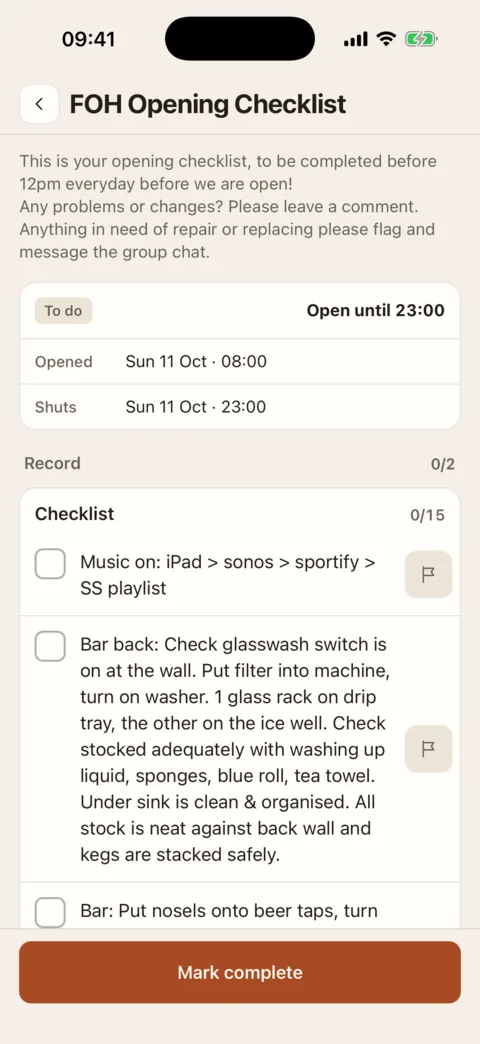
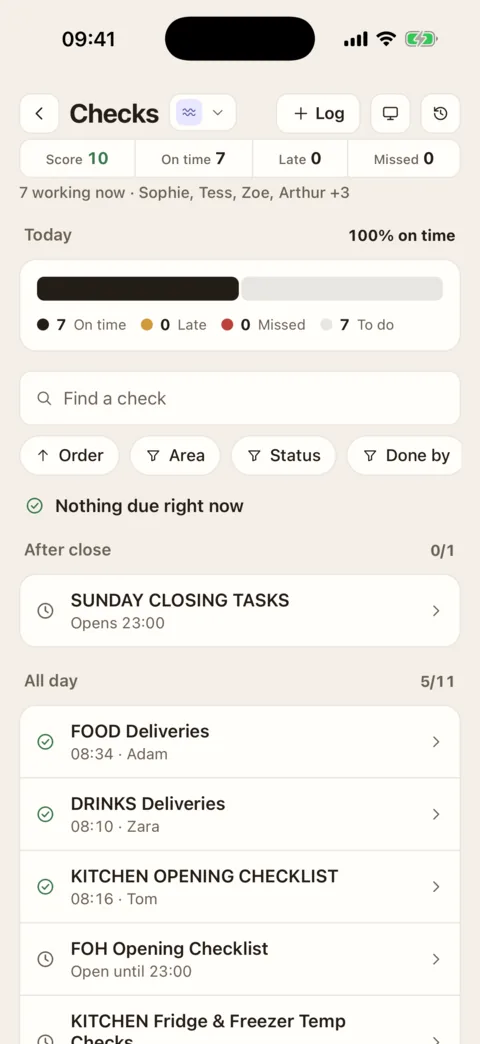
Each record carries the time and the name of who did it, and a failed answer can raise an action for someone to close. The ready-made checks are general. Read each one before you rely on it.
For the rules behind the fridge readings, see kitchen temperature rules for UK restaurants.
Questions people ask
Are opening and closing checks a legal requirement?
A food business must have food safety management procedures and keep records. Opening and closing checks are part of the Food Standards Agency’s Safer food, better business pack for caterers, which is one way a small restaurant meets that. Which checks you need comes from your own food safety plan.
What must a kitchen cleaning schedule include?
The Food Standards Agency’s cleaning guidance says the schedule must cover what needs to be cleaned or disinfected, how often, and which products to use.
Can opening and closing checks be done on an app?
Yes. The Safer food, better business guidance says the diary can be kept electronically. Records must be up to date and available for inspections at all times.
See how it works, step by step
Sources
The Food Standards Agency’s guidance as these pages stood on 17 November 2026, for England, Wales and Northern Ireland. The example checklists on this page are our own. This page is a summary, not food-safety or legal advice.
- GOV.UK (Food Standards Agency), Safer food, better business for caterers: gov.uk/government/publications/safer-food-better-business-for-caterers (read 17 November 2026)
- GOV.UK (Food Standards Agency), Safer food, better business (SFBB): gov.uk/government/publications/safer-food-better-business-sfbb/safer-food-better-business-sfbb (read 17 November 2026)
- GOV.UK (Food Standards Agency), Food hygiene for your business: chilling and freezing: gov.uk/food-hygiene-businesses/chilling-and-freezing (read 17 November 2026)
- GOV.UK (Food Standards Agency), Food hygiene for your business: cleaning: gov.uk/food-hygiene-businesses/cleaning (read 17 November 2026)
- GOV.UK (Food Standards Agency), Allergen guidance for food businesses: gov.uk/government/publications/allergen-guidance-for-food-businesses/allergen-guidance-for-food-businesses (read 17 November 2026)
- GOV.UK (Food Standards Agency), Managing food safety: gov.uk/government/publications/managing-food-safety/managing-food-safety (read 17 November 2026)
All product names are trade marks of their owners. Yes Chef is not affiliated with any of them. If something here is wrong or out of date, write to omar@1273.co.uk and we will correct it.
Want Yes Chef for your restaurant?
The first three months are free. It is offered to a limited number of restaurants, and we set each one up ourselves, so there is no sign-up form and no published price. Write and tell us about yours.
Get in touchNot your restaurant? Refer a restaurant. When it becomes a paying customer, we pay you £500. How referring works