
Management debt: what builds up in a restaurant when the tools don’t get used
- Published
- Updated
Yes Chef makes restaurant management software. This page is written by us, and it is our opinion.
In short
- Management debt is the gap between what happened in a restaurant and what is written down about it.
- It starts when a tool is harder than the job it records. People complain, then stop using it.
- It compounds: each skipped record makes the next less worth doing, until someone rebuilds the week from memory.
- You pay it down one record at a time, by making the record easier than the gap and making a miss visible the same day.
What management debt is
Software people have a name for the cost of every shortcut that was meant to be fixed later: technical debt. Nobody decides to take it on. It arrives one skipped job at a time, and then it charges interest.
Restaurants carry the same thing, in records. Call it management debt. It is the gap between what happened in the building and what is written down about it. You will know it by its usual forms:
- Three weeks of timesheets nobody has approved.
- Fridge checks filled in on Friday for the whole week, in one pen.
- A rota that officially lives in one place and really lives in a group chat.
- Holiday balances that nobody trusts, so every request starts an argument.
- An allergen sheet that is two menus old.
- A new starter trained by whoever was on, with nothing signed off.
None of these is a disaster on the day it starts. Each one is a small loan against a future shift.
How it starts
It rarely starts with laziness. It starts with a tool that loses to the job.
- The tool takes longer than the task. If recording a fridge reading means finding the clipboard, the pen and the right page, the reading gets taken and not written. The chef did the check. The record did not happen.
- The login nobody remembers. One person set the system up. Their password is on a sticky note that went in the bin with the last deep clean.
- Five tools that do not know about each other. The rota does not know who clocked in. The clock does not know who is on holiday. The holiday sheet does not know the hours. So a person has to carry each fact from one to the next, by hand, after service.
- The office is not where the work is. A record that can only be made at the back-office computer will be made later. Later is where debt comes from.
Then people complain about the tool, and they are right to. And because they complain, they stop using it. The complaint is the early warning. The silence that follows is the problem.
How it compounds
One missed day makes the next one less worth doing. A checks sheet with a gap on Tuesday is already imperfect, so Wednesday feels optional. A timesheet list forty long is a different job from one that is four long: nobody opens it between lunch and dinner.
So the catch-up day appears. Someone comes in on their day off, or stays after close, and rebuilds the week from memory, the till and the group chat. That record is worth less than the one that was never made, because it looks finished. A check written down three days late tells you what someone remembers, not what the fridge was at.
And the knowledge pools in one head. There is a manager who knows that Jo swapped Thursday, that the walk-in was running warm, that the new commis has not done allergens yet. While they are in the building it works. When they are off sick, on holiday or gone, the restaurant finds out how much of its management lived in one person.
What it costs
The interest gets paid in a few familiar ways.
- Payroll corrections. Hours approved in a batch get approved wrong. Someone is short, someone is over, and the fix takes longer than the approval would have.
- Holiday nobody can settle. When the hours are unsure, so is the holiday that builds from them. Our post on holiday for zero-hours staff explains why the two are tied.
- An inspection with gaps. The officer usually arrives unannounced, and the records are whatever they are that morning. See what the officer checks and what the rules ask you to record.
- An allergen answer nobody is sure of. A sheet that is out of date is worse than no sheet, because people believe it. The rules are in our allergen guide.
- Breaks and rest nobody can show. If the clock is not used, there is nothing to show a break was taken. The limits are in rest breaks and working hours.
- A tips record you cannot produce. The law asks for one. See tipping and tronc law.
- A new starter with no record. They may be good. Nobody can say what they were shown.
The quiet cost is the largest. Managers who spend their evenings rebuilding last week are not on the floor, not training anyone and not looking at next week.
How to pay it down
You do not clear this with a big tidy-up. A tidy-up is another catch-up day. You clear it by changing which is easier: doing the record, or skipping it.
- Pick one record. Not all of them. The one that hurts most, usually timesheets or the temperature checks. Leave the rest alone for a month.
- Make it the easiest thing on the shift. Fewer fields. The limit written on the check so nobody has to remember it. Nothing asked for that nobody reads.
- Do it where the work is. On the phone in the walk-in, or a tablet on the pass. If it needs the office, it will wait for the office.
- Make a miss visible the same day. A gap you find out about on Friday is debt. A gap someone is told about at half past nine is a job. This is the whole difference.
- Let one entry feed the others. Clocking in should be the timesheet. The timesheet should be the holiday. The recipe’s allergens should be the dish’s. Every fact a person has to copy between systems is a fact that will one day not be copied.
- Do not backfill. Draw a line under the old gap and say so. An honest gap is better than an invented week.
Where Yes Chef fits
This is the problem Yes Chef is built around: one app that holds the rota, the clock, the checks, holiday, training and the menu, so that a fact is entered once, where the work happens. What that means in practice:
- The clock is the timesheet. A timesheet is not a form anyone fills in. It is worked out from the clock: the clock-in, the breaks and the clock-out. One with nothing flagged is approved by itself, so the list a manager opens holds only the ones that need a look.
- The timesheet is the holiday. For someone on zero hours, holiday builds from approved timesheets, and each person can see their own balance.
- A missed check says so, that day. Checks are asked for at their time and carry the time and the name of who did them. One not done in time shows as missed, people are sent a notice, and one filled in afterwards is recorded as done late, never as on time.
- Checks happen where the work is. On a phone, including without a signal, or on a shared tablet where each person gives a PIN.
- Training has a state. Each skill, for each person, is not started, training or signed off, so “has she done allergens?” has an answer.
- The recipe’s allergens are the dish’s. A dish picks up the allergens of the recipes it is linked to.
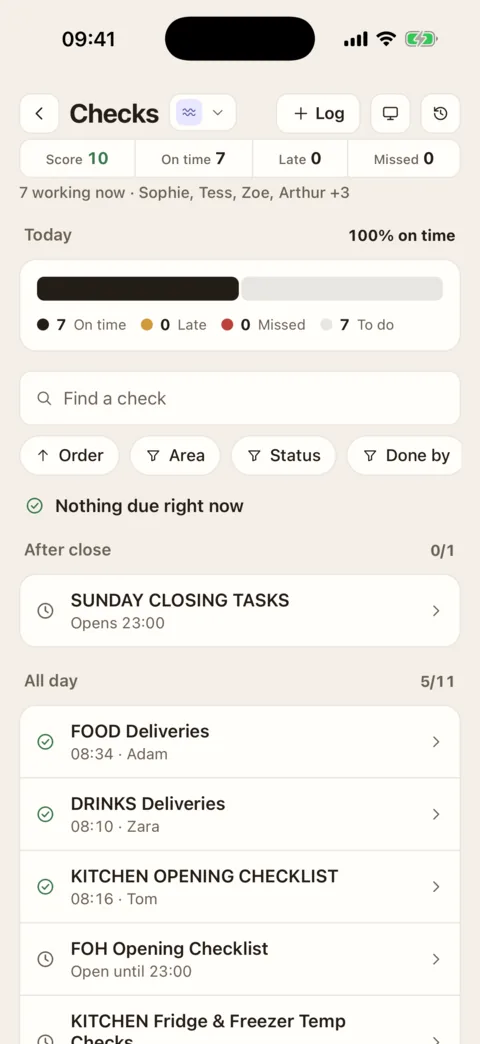
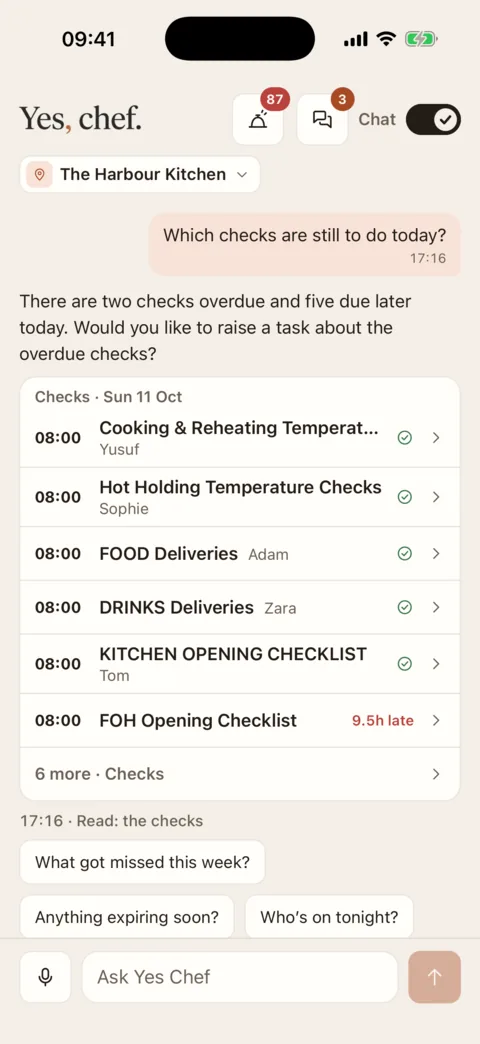
And there is Ask Yes Chef, a chat that looks the answer up in the restaurant’s own records. A manager can ask “What needs me?” and get what is waiting for a decision, who is working now and where the checks stand. That is the same-day visibility, without opening five screens. We have written up what you can ask it.
No app pays the debt for you. Someone still has to take the reading and approve the hours. Software can only make the record cheaper than the gap.
What Yes Chef does not do
- Stock control and supplier ordering are not built yet.
- Sales come in live from one till, SumUp POS Pro.
- There is no sign-up form. It is offered to a limited number of restaurants, and we set each one up ourselves. As an introductory offer, the first three months are free.
- We do not publish a price.
Questions people ask
What is management debt in a restaurant?
It is our name for the backlog of records a restaurant has not kept up: unapproved timesheets, checks filled in days later, an out-of-date allergen sheet, training nobody signed off. Like technical debt in software, it builds one skipped job at a time and gets more expensive the longer it is left.
Why do staff stop using restaurant software?
In our view, because the tool takes longer than the task it records, lives on a computer away from where the work happens, or does not share what it knows with the other tools. People complain first, then quietly stop using it.
Should you backfill missing records?
We think not. A record written days later shows what someone remembers, not what happened, and it looks complete when it is not. Draw a line under the gap and keep the record properly from then on.
How do you clear a backlog of restaurant admin?
Pick one record, not all of them. Make it the easiest thing on the shift, do it where the work is, make a missed one visible the same day, and let one entry feed the others so nobody copies facts between systems.
See how it works, step by step
Sources
This page states no facts about other companies.
All product names are trade marks of their owners. Yes Chef is not affiliated with any of them. If something here is wrong or out of date, write to omar@1273.co.uk and we will correct it.
Want Yes Chef for your restaurant?
The first three months are free. It is offered to a limited number of restaurants, and we set each one up ourselves, so there is no sign-up form and no published price. Write and tell us about yours.
Get in touchNot your restaurant? Refer a restaurant. When it becomes a paying customer, we pay you £500. How referring works